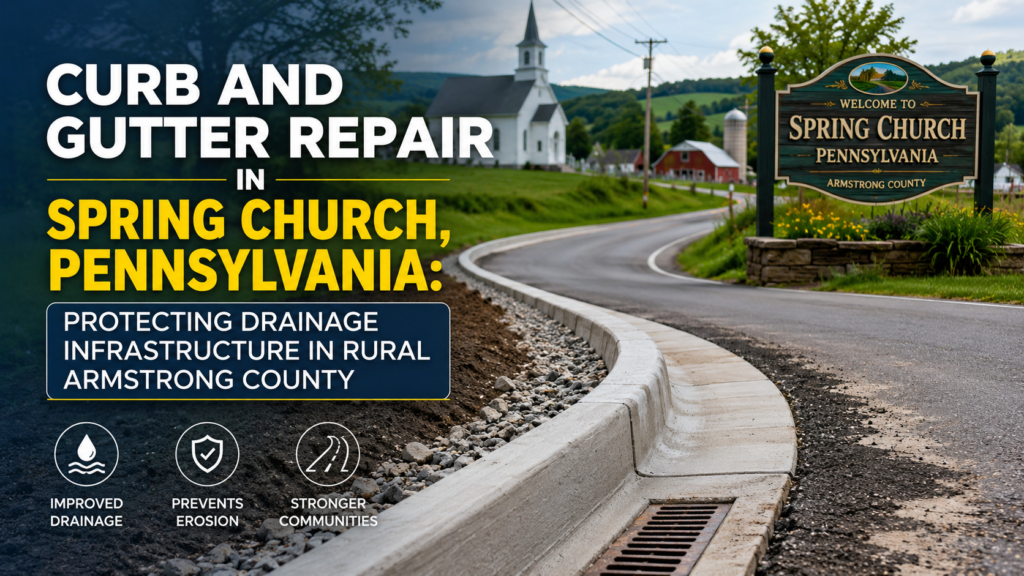
Curbs and gutters may be among the least noticed elements of a property until they fail and in Spring Church, Pennsylvania, where the rolling terrain of the Kiskiminetas River valley creates significant drainage demands on every paved surface, properly functioning Curb and Gutter Repair Spring Church systems are essential infrastructure rather than decorative afterthoughts. For homeowners and commercial property owners throughout Armstrong County, understanding what curbs and gutters do, why they deteriorate in this climate, and what proper repair involves protects both the pavement these systems border and the broader property they serve.
The Functional Role of Curbs and Gutters
Curbs and gutters work together as an integrated system that performs several distinct but related functions on any property where they are installed:
- Stormwater channeling: The gutter the low channel running along the base of the curb collects surface water runoff from paved areas and directs it toward catch basins, drainage inlets, or other designed outlets. Without this directed channel, water disperses unpredictably across pavement and adjacent ground, saturating sub-base material and accelerating pavement deterioration.
- Pavement edge confinement: Curbs provide lateral support to the edge of asphalt pavement. Without this confinement, asphalt at pavement edges gradually spreads and crumbles under traffic loads a deterioration pattern called edge raveling that is highly visible on unconfined rural driveways and parking areas throughout Armstrong County.
- Traffic and pedestrian guidance: Curbs establish clear physical boundaries between vehicle travel areas, parking areas, and pedestrian or landscaped zones, preventing vehicle encroachment and providing visual guidance for drivers.
- Foundation protection: By directing water away from buildings, properly functioning curb and gutter systems reduce the moisture load on building foundations a meaningful protective function in a region where foundation movement related to moisture cycling is a recognized concern.
Why Armstrong County Climate Damages Curb and Gutter Systems
Western Pennsylvania weather conditions create specific damage mechanisms for concrete curb and gutter infrastructure:
- Freeze-thaw spalling: Water that penetrates micro-cracks and surface pores in concrete freezes and expands, breaking off surface layers in a process called spalling. Over successive Armstrong County winters, repeated freeze-thaw cycling progressively roughens and weakens curb surfaces, eventually exposing aggregate and creating irregular, crumbling edges.
- Salt and de-icing chemical damage: Road salt and other de-icing materials applied to driveways, parking areas, and adjacent roads accelerate concrete deterioration by drawing additional moisture into the material and introducing chloride ions that corrode any embedded steel reinforcement, causing internal expansive cracking.
- Root intrusion: In the wooded and landscaped areas common throughout the Spring Church area, tree roots growing beneath or alongside curb sections can generate enough upward and lateral force to crack, lift, and displace concrete over time.
- Vehicle impact: Curbs at driveway entrances, parking lot corners, and tight turning areas are subject to occasional vehicle contact that cracks and displaces concrete sections, particularly where drivers must navigate Armstrong County narrow rural roads and tight commercial access points.
- Sub-base erosion: Inadequate base preparation or drainage failures beneath curb sections can allow erosion of the supporting material, causing sections to settle unevenly and disrupting the intended drainage slope.
Types of Curb and Gutter Repair
Repair approaches vary based on the extent and nature of the damage observed:
- Joint sealing: The expansion and construction joints between individual curb sections can open over time as the concrete moves seasonally. Cleaning and resealing these joints with flexible sealant is a low-cost preventive measure that keeps water from penetrating the joint and undermining the base beneath.
- Surface patching: Localized spalling or surface chipping on otherwise structurally sound curb sections can often be repaired with a bonded concrete patching compound, restoring the surface without requiring full section replacement.
- Section replacement: When a curb section is cracked through, significantly displaced, or has lost structural integrity, the damaged section is saw-cut at the nearest joints, removed, and replaced with newly poured concrete matching the original profile.
- Full reconstruction: In cases where an entire curb and gutter run has failed common on older rural commercial properties or aging residential developments where the original system has reached the end of its service life complete removal and reconstruction restores proper function and appearance.
The Section Replacement Process
For the most common significant repair replacing a damaged curb section the process follows a defined sequence: the damaged section boundaries are precisely saw-cut, ideally at existing joint locations to minimize disruption to adjacent sound sections; the damaged material and any compromised base beneath it are removed; the sub-base is inspected and repaired with compacted aggregate as needed to restore proper bearing and drainage; formwork matching the existing curb profile is installed, including correct height, gutter channel dimensions, and any necessary driveway apron transitions; air-entrained concrete meeting Pennsylvania freeze-thaw durability standards (typically a minimum 4,000 PSI compressive strength) is placed and finished; and the new concrete is properly cured for a minimum of seven days before being opened to traffic.
Coordinating Curb Repair with Broader Pavement Maintenance
For Spring Church property owners planning asphalt resurfacing, overlay, or replacement work, addressing curb and gutter condition before the paving project rather than after is the more practical sequence. Paving up to or around damaged curb sections locks the existing problem into the new surface and limits future repair options without disturbing the fresh asphalt. When curb replacement is planned alongside paving work, it is also a natural opportunity to evaluate the broader drainage system: confirming that gutter slopes adequately convey water to outlets, that any catch basins or drainage structures are functioning properly, and that the overall system will perform effectively once the new pavement is in place.
Conclusion
Curb and gutter repair in Spring Church and throughout rural Armstrong County addresses infrastructure that, while often overlooked, plays an essential role in protecting pavement, managing stormwater, and guiding safe vehicle and pedestrian movement. Understanding the functional importance of these systems, recognizing how Western Pennsylvania climate damages them through freeze-thaw cycling and salt exposure, and knowing what proper repair involves equips property owners in this rural community to maintain infrastructure that protects the broader pavement investments it borders.